






 Women’s participation in politics in Bangladesh appears to be declining, with the latest parliamentary election producing one of the lowest levels of female representation in the country’s electoral history. In the recently concluded 13th National Parliament election, the proportion of female candidates stood at just 3.93 percent—less than four percent of all contestants. Only 85 women ran in the election, including 66 nominated by political parties and 19 running as independent candidates. Among them, only seven women were elected to parliament. The victory rate among female candidates was therefore extremely low, amounting to only about 2.33 percent.
Of the seven women elected in the latest election, six were nominated by the ruling Bangladesh Nationalist Party (BNP), while one was elected as an independent candidate. The BNP had fielded ten female candidates in total. Meanwhile, Jamaat-e-Islami, which sits in the position of the main opposition in parliament, did not nominate any female candidate at all. This decision had already sparked considerable debate before the election took place. Jamaat’s alliance partner, the National Citizens Party (NCP), nominated three women candidates, but none of them succeeded in winning their races. Other political parties also nominated a small number of female candidates, yet none of them managed to secure victory. In fact, the deposits of the majority of those candidates were forfeited due to poor electoral performance.
Experts say that the level of participation and success among female candidates in this election is the lowest among all national elections held since the country’s independence. They see it as a clear indicator that women’s participation in national politics is shrinking rather than expanding. According to analysts, increasing women’s participation in politics and policymaking will require coordinated initiatives. They emphasize the need to ensure a violence-free political environment and greater state investment in programs that promote women’s political engagement.
Historical statistics show that women’s presence in parliament has fluctuated but generally increased over time until the recent setback. In the first national parliament formed in 1973 after independence, there were 15 female members of parliament, representing about 4.8 percent of the total. In the second parliament in 1979, the number rose to 32, or roughly 9 percent. The third parliament in 1986 had 33 women, representing about 10 percent. In 1991, the fifth parliament had 35 women, or 10.6 percent of the members. The sixth parliament formed in 1996 had 33 women, about 10 percent, while the seventh parliament later that year had 38 women, representing 11.5 percent. In 2001, the eighth parliament saw a significant rise to 52 female members, or 15.1 percent. The ninth parliament elected in 2008 included 71 women, about 20 percent of the chamber. The tenth parliament formed in 2014 had 69 women, or 19.7 percent. The eleventh parliament elected in 2018 included 72 women, accounting for about 20.6 percent. The twelfth parliament elected in 2024 had 69 women, representing about 19.7 percent. Only once before had female representation dropped sharply—in 1988, during the fourth parliament, when just four women served as members, amounting to only 1.3 percent of the total. However, the most recent thirteenth parliament has now recorded another dramatic decline, with female representation falling to roughly 2.33 percent.
Despite this decline, the newly formed BNP-led government has included several women in its cabinet. Among the seven female members of parliament elected in the latest election, three have been appointed to ministerial positions. One has been given a full ministerial portfolio, while two others have been appointed as state ministers. As a result, about 42.86 percent of the elected female MPs are now part of the policymaking executive branch. Experts say that although this is a small number overall, it provides an opportunity to strengthen women’s political influence in decision-making bodies.
At the grassroots level, however, the picture looks somewhat different. In local government institutions—such as union parishads, municipalities, city corporations, and district councils—a large number of women are elected to reserved seats. Positions such as vice-chairperson, councilor, or member are often specifically reserved for women. This system has helped create a foundation for women’s participation in politics at the local level.
Yet research suggests that even when women are elected to local government positions, they often lack real authority in decision-making. In many cases, family members or influential male political figures exercise informal control over the positions held by female representatives. As a result, the presence of women in these institutions sometimes exists more in form than in substance, while patriarchal power structures continue to dominate behind the scenes.
The marginalization of women is also visible within the leadership structures of political parties. In 2008, women accounted for only about 10 percent of leadership positions within political parties across the country. When the issue of women’s empowerment gained greater attention, the Representation of the People Order (RPO) of 1972 was amended. The amendment required political parties to ensure that women held at least 33 percent of leadership positions at all levels of their party structures by 2020.
However, when the deadline arrived in April 2020, it became clear that no political party had achieved this target. Even in parties where female leadership was relatively stronger, the proportion rarely exceeded 20 percent. Under the amended RPO, the Election Commission had the authority to cancel the registration of any political party that failed to comply with the requirement. But in April and May of 2020, the Election Commission announced plans to introduce a separate law governing political parties. In a draft version of that proposed law, the deadline for implementing the 33 percent female leadership requirement was removed altogether.
This decision drew strong criticism from political parties and various civil society groups. Eventually, the Election Commission revised its proposal and extended the deadline by another five years, setting 2025 as the new target for achieving the 33 percent requirement.
Following the mass uprising of 2024, initiatives were taken to reform the state’s political structure. After eight months of discussion, the National Consensus Commission formed by the interim government drafted what became known as the July Charter. However, critics say that the charter further reduced ambitions regarding women’s political participation and empowerment.
Women’s groups had demanded that the number of reserved seats for women in parliament be increased from 50 to 100. They also called for a requirement that at least 33 percent of candidates in direct elections be women. But due to objections from political parties, the final version of the July Charter reduced that demand to just five percent. Notably, women were not included in the discussions of the National Consensus Commission during its deliberations. Moreover, none of the political parties that signed the July Charter—including both ruling and opposition parties—implemented the provision requiring five percent female candidates in the thirteenth parliamentary election.
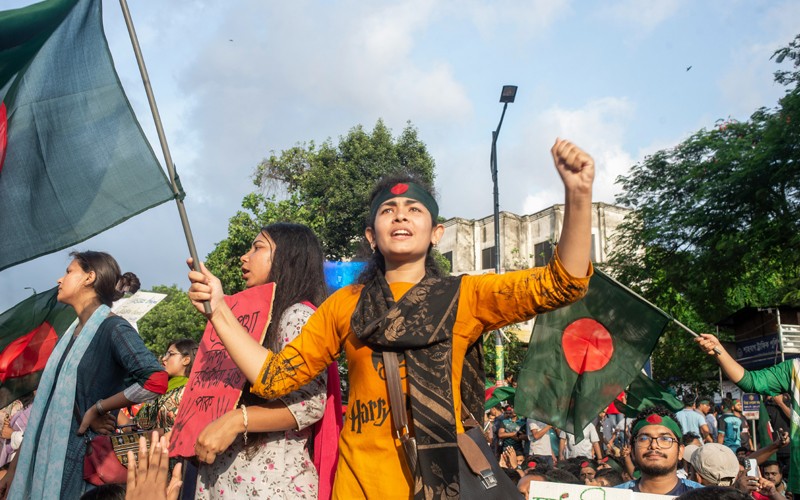
Experts argue that even the provisions included in the July Charter effectively reduced women’s participation and empowerment in politics. This is particularly striking, they say, because women played a leading role in the mass uprising of 2024. Historically, women have also played crucial roles in many of the country’s movements and struggles, including the Liberation War of 1971. Yet after these movements succeed, women often find themselves marginalized again. Analysts say this pattern contradicts the ideals of both the Liberation War and the mass uprising.
To ensure genuine political empowerment for women, experts argue that opportunities for women to contest elections directly must be expanded. Political parties must also ensure equal participation for women within their internal structures. At the same time, they emphasize that simply increasing the number of female politicians is not enough. Women must also be given real influence in political decision-making processes.
Dr. AZM Zahid Hossain, the minister of women and children affairs and social welfare and a member of the BNP standing committee, told the newspaper Samakal that democracy and voting rights have been restored in the country since the political changes of August 5, and a new government has taken office. According to him, the BNP and its government have always been supportive of the development and empowerment of female leadership and will continue to do so. He said the government will soon take various initiatives in this regard and expressed hope that positive results will follow.
Election expert and former additional secretary of the Election Commission Jesmin Tuli said political parties must take the lead in bringing women forward in politics. They need to nominate more women candidates in elections and must implement the RPO requirement of establishing 33 percent female leadership within party structures. Doing so, she said, would significantly increase women’s participation in politics and strengthen their empowerment.
Rasheda K. Chowdhury, executive director of the Campaign for Popular Education, emphasized that women constitute half of the country’s population and therefore cannot be ignored in politics. She argued that establishing female leadership requires coordinated efforts from political parties as well as other stakeholders. Political parties, she said, must be held accountable and encouraged to create opportunities that allow women to use their talent, intelligence, and leadership abilities in national politics.
আপনার মতামত জানানঃ