






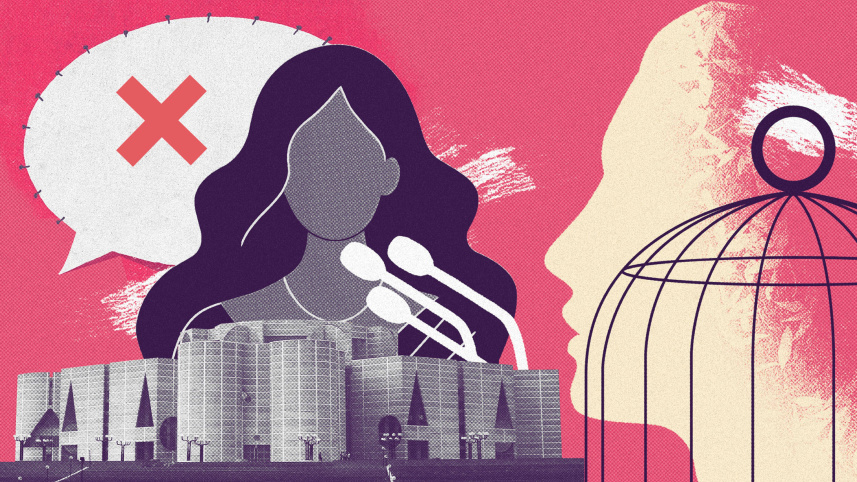
In the February 12 national election, Bangladesh Jamaat-e-Islami did not nominate a single woman for a general parliamentary seat. This absence was not accidental, nor was it a tactical oversight. It reflects a long-standing ideological position rooted in the writings of Maulana Abul A’la Maududi, the intellectual architect of the Jamaat movement.
At the same time, women leaders within the party publicly maintain that Jamaat promotes women’s development, provides leadership training, and ensures significant internal representation. The tension between symbolic inclusion and formal exclusion sits at the heart of the party’s gender politics.
To understand this dynamic, three interconnected dimensions must be examined: Maududi’s foundational ideas on women and public life; the contemporary rhetoric of Jamaat leaders; and the party’s actual electoral behaviour during the February 12 cycle. Together, these reveal a pattern not of contradiction, but of continuity.
Maududi approached women’s public presence not as a matter of social change or practical necessity, but as a civilisational concern. In his writings, increased visibility of women in marketplaces, educational institutions, workplaces, and cultural spaces was framed as evidence of moral deterioration. Public participation by women was not treated as neutral; it was interpreted as destabilising.
Within this framework, the perceived moral crisis does not stem from exploitation, structural injustice, or unequal institutions. Instead, it is tied to women’s visibility itself. Gender interaction is portrayed as inherently risky, with responsibility placed disproportionately on women to withdraw from public space. Men’s accountability recedes, while control over women’s movement and appearance becomes central to maintaining social order.
This worldview also restricts women’s authority over their own bodies and reproductive decisions. Hardship is sometimes framed as virtuous, particularly in economically vulnerable contexts. Most significantly, political leadership by women is rejected outright. In Maududi’s conception, women may vote or participate in supportive roles, but ultimate authority rests with men. Even proposals such as separate female legislative bodies lack genuine power, functioning more as symbolic structures than autonomous institutions.
In Bangladesh, however, women have led governments, organised labour movements, managed industries, served as judges and ministers, and shaped public discourse across sectors. The country’s lived reality includes female political leadership at the highest levels. Jamaat’s model, therefore, does not mirror national consensus; it reflects a particular ideological enclave.
The February 12 election illustrates this ideological continuity. Jamaat’s decision not to field any women candidates aligns closely with its inherited framework. Publicly, however, party representatives have framed the absence differently.
Nurun Nesa Siddika, a senior figure in the party’s women’s wing, stated that leadership roles in Islamic organisations are reserved for men, describing them as directors over women. She suggested that the position of Ameer is not a priority for women and presented this arrangement as acceptable within the party’s structure. Such statements shift the discussion away from the principle of equal political rights and toward a narrative that treats exclusion as voluntary acceptance.
Similarly, Professor Dr. Habiba Chowdhury Sweet has argued that Jamaat is committed to women’s rights and emphasised that women make up a substantial portion of the party’s organisational structure. She highlighted training initiatives and grassroots engagement. Yet the lack of female candidates remains. Internal participation without access to candidacy or decision-making authority raises important questions about what constitutes genuine representation.
Representation measured solely by numerical presence inside organisational layers differs from representation through electoral nomination and political authority. Administrative involvement does not automatically translate into policymaking power. When women are encouraged to mobilise voters and strengthen the party base but are barred from standing for general seats, participation is carefully bounded.
This structure resembles earlier ideological formulations in which women may consult or assist but do not govern. The rhetoric of empowerment exists alongside firm structural limits.
The intellectual environment within affiliated student circles reinforces these patterns. Texts circulated in organisational libraries often frame modernity as morally corrosive and depict Western feminism as destructive. Women’s autonomy, workplace participation, and public visibility are described as symptoms of civilisational decline. Motherhood and domestic roles are elevated as primary responsibilities. Gender interaction outside narrow parameters is cast as inherently dangerous.
Such materials treat feminism as a singular Western intrusion rather than a diverse global conversation that includes Muslim scholars, faith-based reformers, and postcolonial thinkers. Alternative interpretations are frequently dismissed as cultural capitulation, leaving little room for pluralism in understanding women’s rights.
A further tension emerges in the way freedom is defined. On one hand, proponents claim that women willingly embrace veiling, domestic roles, and male guardianship. On the other hand, alternative choices are denounced as immoral or corrupt. If choices are truly free, the intensity of condemnation toward different paths becomes difficult to reconcile. Freedom appears to be reinterpreted not as the ability to decide among options, but as adherence to a prescribed role.
Contemporary party leadership statements reinforce these themes. Jamaat’s Ameer, Shafiqur Rahman, has publicly stated that women cannot lead the party. In a now-deleted social media post, he equated certain forms of women’s public engagement with moral decline, later attributing the message to hacking. Nonetheless, the broader ideological pattern remains consistent.
Policy proposals have reflected similar assumptions. Suggestions to limit women’s working hours have been presented as protective measures, yet critics argue they risk reinforcing domestic confinement rather than addressing structural barriers to economic participation.
Statements concerning sexual violence have also drawn attention. Claims that rape occurs only outside marriage and rejection of marital rape as a concept effectively collapse the question of consent into marital status. By doing so, coercion within marriage becomes conceptually invisible. Classical Islamic jurisprudence contains debates around harm and coercion, yet selective interpretations are often invoked to preserve male authority within the household.
These positions stand in contrast to Bangladesh’s socio-political trajectory. Women have not merely entered public life; they have shaped it. They lead factories, civil society organisations, ministries, and courts. Their participation is not an exception but a structural feature of national development.
Jamaat’s stance, therefore, is not simply a lag behind modernisation. It represents a deliberate adherence to a hierarchical moral order developed in the mid-twentieth century. From Maududi’s writings to contemporary statements by party officials, the ideological thread remains intact. Women may organise, campaign, and vote. They may train and mobilise. But ultimate authority is reserved for men.
The broader democratic question is not about symbolism, but about political subjecthood. Are women full and equal actors within the state, or are they permanently positioned as managed participants? Jamaat’s framework answers that question through structured limitation rather than open inclusion.
As Bangladesh moves through its electoral cycle, the contrast between ideological rigidity and social reality becomes increasingly visible. The debate is not merely theological. It concerns the boundaries of citizenship, authority, and equality in a society where women’s leadership is already deeply embedded in public life.
আপনার মতামত জানানঃ