






 In political conversations across Dhaka, a single place name has taken on an outsized meaning. “Kochukhet” is no longer just a neighbourhood near the capital’s cantonment; it has become a metaphor people use when discussing where real power lies in Bangladesh. When debates turn to who ultimately shapes political outcomes, Kochukhet is invoked as shorthand for the military’s shadow over civilian life.
That debate has intensified as Bangladesh approaches a national election scheduled for February 12, the first since the dramatic 2024 uprising that brought an end to Sheikh Hasina’s 15-year grip on power. Her fall, triggered by a student-led mass movement and followed by her flight to India, ushered in an interim administration headed by Nobel Peace Prize laureate Muhammad Yunus. The coming vote is meant to restore constitutional normalcy, but it is unfolding in an atmosphere shaped heavily by the armed forces.
The military is not contesting the election, nor has it announced any ambition to govern directly. Yet it has become central to the political environment as the most visible guarantor of order. The police force remains weakened after the turmoil of 2024, its morale and capacity damaged by years of politicisation and by its role during the uprising. At the same time, Bangladesh is still reckoning with a security apparatus that rights groups and official investigations say was repeatedly used to influence politics under Hasina.
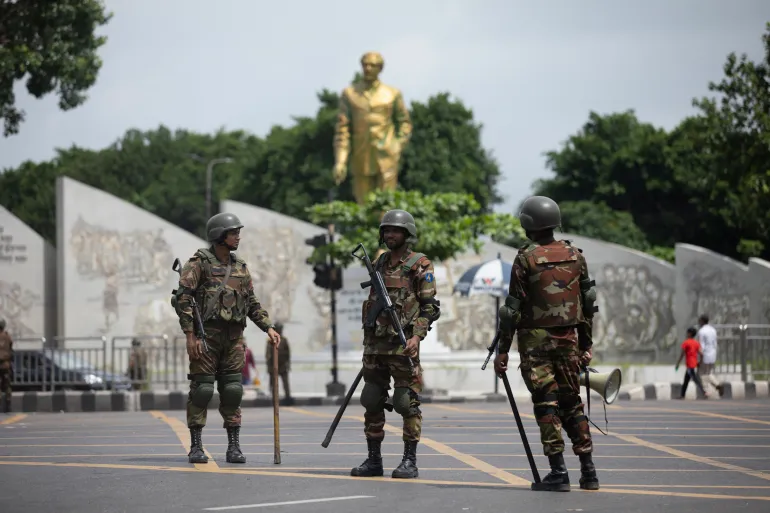
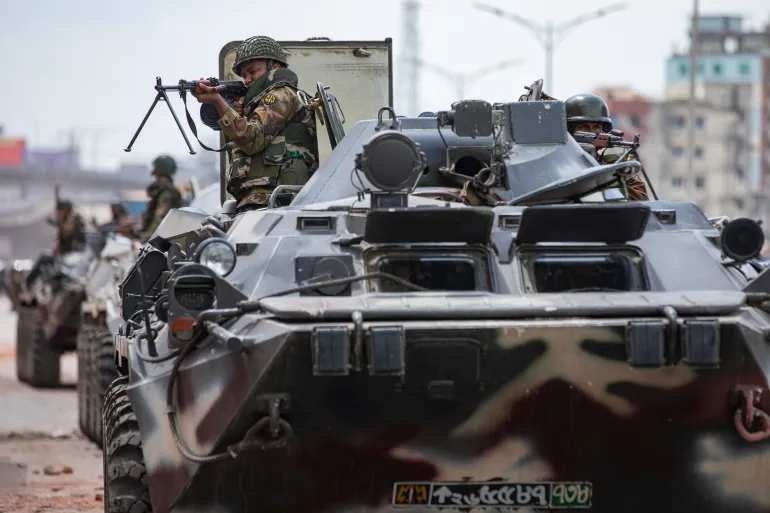
For more than a year, soldiers have been a routine presence on Bangladesh’s streets, operating under executive orders that grant them magisterial powers to support law and order. During the election, that presence will expand further. Officials have indicated that up to 100,000 troops could be deployed nationwide, and proposed amendments to election regulations would formally list the armed forces as one of the poll’s law-enforcing agencies.
This prominence inevitably revives old anxieties. Bangladesh, a country of more than 170 million people wedged between India and Myanmar, has a long history of military interventions in politics. The memory of coups, counter-coups and periods of direct military rule continues to shape how citizens interpret the present. Analysts broadly agree that the army today is not positioned for an overt takeover. Still, they argue, it remains a decisive centre of power: an institution deeply embedded in the state, capable of shaping civilian choices through its control of security, intelligence and its extensive footprint across government and the economy.
Observers of Bangladesh’s civil-military relations describe the current moment as one of paradox. On the one hand, senior officers have repeatedly signalled that they want a return to elected government. On the other, the army’s centrality to public order and its willingness to speak publicly about political timelines have blurred the boundary between support and influence.
International Crisis Group analyst Thomas Kean has described the army as “backstopping” the interim administration, not just politically but through day-to-day security in the absence of a fully functional police force. According to him, the institution wants elections to take place smoothly so the country can regain constitutional footing and the soldiers can return to their barracks. Had the army wanted to seize power outright, Kean argues, it could have done so when the political order collapsed in August 2024. Instead, it refrained, having learned from the costs of past experiments with direct rule.
Local analysts add that pragmatic self-interest also plays a role. A military takeover would have jeopardised Bangladesh’s lucrative and prestigious participation in United Nations peacekeeping missions, which provide hundreds of millions of dollars annually in reimbursements and carry significant international standing for the armed forces.
Yet even those who reject the idea of an imminent coup emphasise that the army remains a major political actor. Its influence today is subtler than tanks on the streets, operating instead through institutional weight, intelligence networks and economic reach. The military’s “corporate” footprint extends from large infrastructure projects to its own business conglomerates, as well as the presence of serving and retired officers across state bodies and commercial enterprises.
Critics argue that this influence was normalised during Hasina’s rule, when the armed forces were granted a generous share of economic and institutional privileges. That legacy, they warn, could translate into informal pressure on future civilian governments to preserve the same arrangements, and into anxiety within the ranks about losing accumulated benefits.
Most analysts nevertheless see the risk of overt intervention as low, barring a catastrophic breakdown in law and order that creates public demand for the army to step in as the only remaining source of stability. Former officers and retired generals have also stressed that neutrality is now understood within the institution as essential to preserving what remains of its public credibility.
 The army’s decisive role during the 2024 uprising looms large in these assessments. As protests escalated and violence spread, the military refused to fully enforce curfew orders and chose not to fire on civilians. It facilitated Hasina’s departure and announced the formation of an interim government. Many Bangladeshis credit that stance with preventing far greater bloodshed. The army chief at the time publicly insisted that shooting civilians was incompatible with military culture and reiterated that the armed forces should not engage in politics.
History, however, makes such assurances fragile. After the assassination of Sheikh Mujibur Rahman in 1975, Bangladesh entered a turbulent era dominated by military interventions. Out of that period emerged political forces that still define the country, including the Bangladesh Nationalist Party, founded by former army chief Ziaur Rahman after he transitioned from military ruler to civilian leader. Another army chief, Hussain Muhammad Ershad, seized power in 1982 and ruled for much of the decade before being forced out by a mass pro-democracy movement led by Khaleda Zia and Sheikh Hasina.
Although the restoration of parliamentary democracy in the 1990s reduced the army’s overt role, it never fully disappeared from politics. In 2007, amid election-related chaos and violence, the military backed a technocratic caretaker government widely seen as operating under its shadow. Only after Hasina’s return to power in 2009 did the armed forces become firmly subordinate to civilian authority, though critics argue that this subordination came at the cost of politicisation.
That legacy is now being re-examined. Human rights organisations have documented widespread abuses during Hasina’s tenure, including enforced disappearances, extrajudicial killings and the use of security agencies against political opponents. A national commission of inquiry has verified more than 1,500 cases of enforced disappearance and described the practice as a tool of political repression, particularly around election periods. The military-run intelligence agency, DGFI, has also been accused of interfering in past polls.
Several senior officers, including those still in service, now face trials in civilian courts over allegations of enforced disappearances, torture and murder. Such proceedings are rare in Bangladesh and have become a sensitive test of civil-military relations. Some see them as a source of tension between the interim government and the army leadership; others argue they offer the institution a chance to reclaim professionalism and public trust by holding individuals accountable.
Against this backdrop, even limited public statements by senior generals take on political significance. When the army chief publicly pledged unconditional support for the interim government and suggested election timelines, critics accused him of straying beyond his mandate. Subsequent remarks reiterating preferred deadlines for polls deepened concerns that the military was edging too close to dictating political outcomes, even if unintentionally.
The deeper question facing Bangladesh is not whether the army wants to rule, but whether the country’s political system can prevent security institutions from once again becoming instruments of partisan power. Analysts argue that while the military will remain influential, its long-term role should be that of a stabiliser committed to civilian supremacy, not an arbiter of politics.
That responsibility, they stress, does not rest with generals alone. Civilian politicians must also resist the temptation to rely on the military for short-term advantage. Only if elected leaders are accountable to voters rather than to men in uniform, many argue, can Bangladesh finally consign Kochukhet to being just another neighbourhood, not a symbol of who truly holds the reins of the state.
আপনার মতামত জানানঃ