







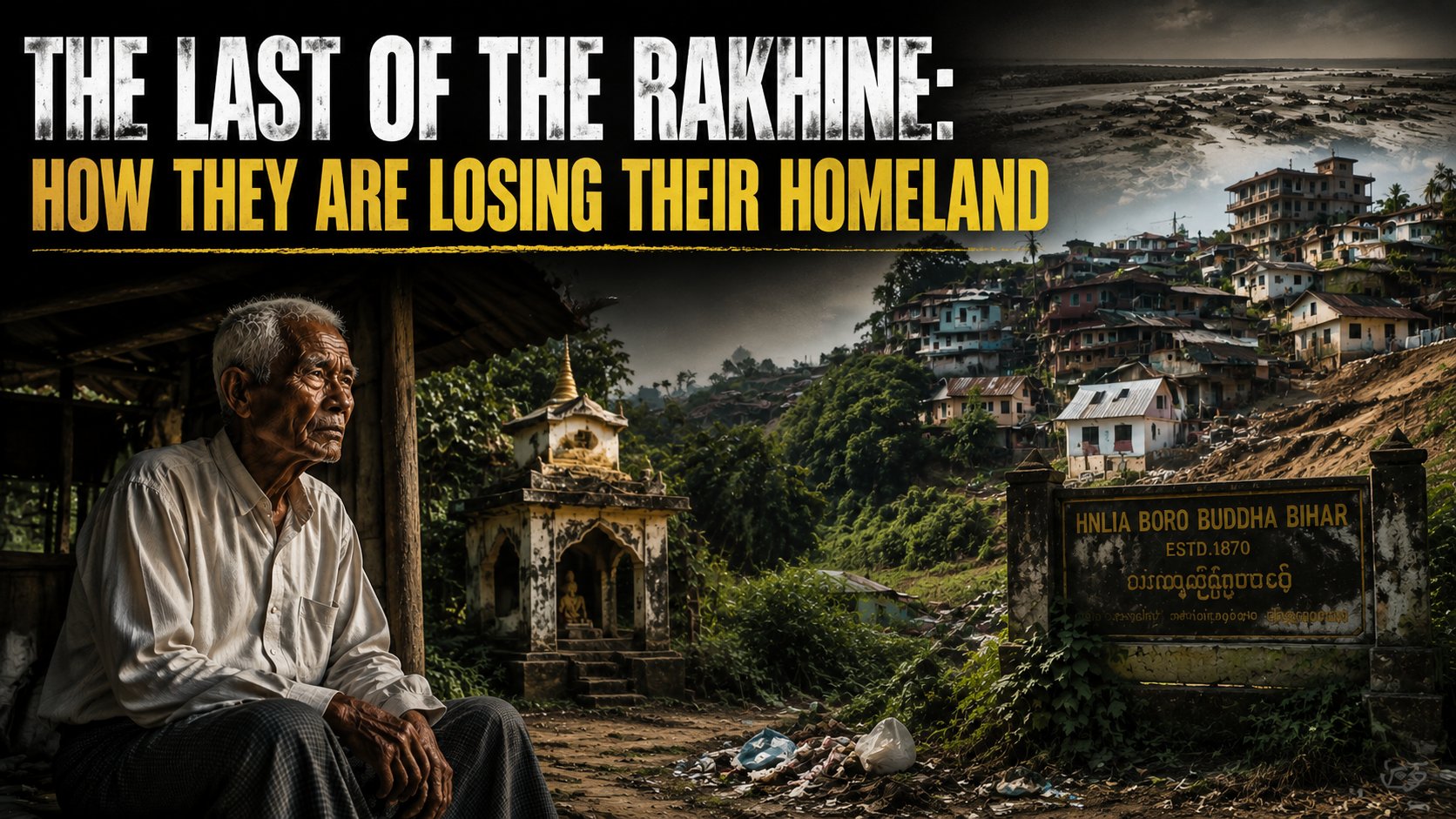
 In a village that still bears its old name, an elderly man sits beneath a tin roof and describes a home that has already, in every meaningful sense, ceased to exist.
Mong Prow is seventy years old. He lives with his wife in Mogpara, a settlement near Bangladesh’s southern border with Myanmar that was once home to three dozen Rakhine families. Today, only two remain — his own household, and that of a widow who lives alone among the betel nut trees next door. Even his adult daughter has left, unable to bear the isolation of a place emptied of the community that once anchored it.
“Even if I go to Teknaf, my heart does not want to stay there,” he has said, describing an attachment to home that outlasts the practical reasons to leave.
His story is not unusual. It is, in fact, close to the norm for what remains of one of Bangladesh’s smallest indigenous peoples — a slow-motion disappearance playing out across dozens of villages, temples, and burial grounds along the country’s southeastern coast.
The scale of the decline is difficult to overstate. A researcher’s survey conducted in the late 1940s counted more than five thousand Rakhine families spread across 164 villages. By the time Bangladesh’s most recent national census was compiled in 2022, the entire Rakhine population of the country had fallen to just over 11,000 people — a figure spread thinly across Cox’s Bazar, Patuakhali, Barguna, and a handful of other districts.
In Teknaf, the southernmost administrative area in Bangladesh and once a stronghold of Rakhine settlement, the collapse has been especially severe. Of 33 villages that once housed Rakhine families, only six still do. The rest survive only as place names — Nayapara, Dhomdhomiya, Jadirpara — attached to land now occupied by other communities. Rakhine residents began leaving these villages in significant numbers around 2004, as the arrival of Rohingya refugees from Myanmar reshaped the region’s demographics and, by the accounts of community leaders, deepened a sense of insecurity that had already been building.
What’s left of the community in Teknaf numbers fewer than a thousand people, split across a handful of remaining hamlets — the largest holding perhaps a hundred families, the smallest down to two or three households clinging to land their ancestors settled generations ago.
Nowhere is the erosion more visible than at the region’s religious sites. Buddhist temples, monasteries, and cemeteries — the institutions that have historically bound Rakhine communities together — have been encroached upon, built over, or dismantled outright.
Satellite imagery stretching back more than two decades tells the story with unusual clarity. In one village in Hnila union, home to a sacred pagoda known locally as a jadi, images from the early 2000s show the religious site still surrounded by open, undeveloped land. Over the following twenty years, frame by frame, houses crept closer. By the mid-2020s, homes stood directly adjacent to the holy site, with household waste piling up nearby. The village that once housed some 250 Rakhine families is now home to just twelve.
A short distance away, an entire monastery vanished. Established in 1870 on more than ten acres of hillside, the Hnila Boro Buddha Bihar — also known by its Rakhine name — was clearly visible in satellite photography as late as 2010. Two years later, it was gone. In its place: a farm, ornamental gardens, and a recreational building linked to the son of a former member of parliament. More than thirty families from outside the Rakhine community now live on what was once monastery land. Two Buddha statues survive, confined to a small tin-roofed room — remnants of a religious complex that once anchored the area.
The paper trail behind this particular loss is striking, because it shows that officials were warned well in advance and largely failed to act. Rakhine leaders and Buddhist monks formally petitioned the government in 2009 to enforce existing protections for the site. Three years later, following an inspection, a district commissioner ordered the eviction of the families occupying the land and the removal of the structures built there. An official eviction case was opened.
None of it was enforced. According to the monastery’s general secretary, a senior monk was manipulated into signing blank stamped paper under the pretext of arranging an electricity connection — paper that was later used to produce what he has described as a fraudulent 99-year lease. When the monk pushed back, monks at the site say they faced robberies and threats until they abandoned the property altogether in September 2012. The monastery building itself was subsequently taken apart.
A journalism professor at Dhaka University who has visited the site put the episode in blunt political terms: the parliamentarian linked to the encroachment belonged to the ruling party of the time, and the state, in his assessment, allowed the seizure to happen in plain view. It was only after the political upheaval of July 2024 that local authorities returned part of the property to the Rakhine community — thirteen years after the dispute first began.
Similar patterns recur elsewhere along the coast. In Cox’s Bazar town, official records list some 35 acres belonging to nine Buddhist temples, but community leaders say much of that land has been occupied in practice. At one temple near the beach and the international airport, a hillside has been cut into and covered with houses and multi-story buildings, despite standing government orders to remove the illegal structures and restore the site. As of late 2025, a newly appointed district commissioner acknowledged the problem but had yet to act on it nearly a year into his tenure.
The losses extend beyond real estate. Burial grounds — often the most emotionally significant sites for any community — have been swallowed by the same pressures.
In Mogpara, the cemetery where Mong Prow’s parents and relatives were buried disappeared as the surrounding land was gradually taken over. Villagers now travel roughly six kilometers to bury their dead along the Naf River, at a site where part of a century-old graveyard has itself been reduced to a dumping ground for household refuse.
Further west, in Patuakhali district, the story repeats with painful specificity. The Payra Seaport development project displaced the final six Rakhine families from the village of Chho-Anipara in 2022, absorbing not just their homes but their cremation ground into a construction zone. The village chief has described the loss in stark terms: the site held the remains of his mother, father, and brother, and its disappearance amounts to the erasure of the family’s collective memory. Former residents, now scattered, carry with them photographs of the homes they left behind and of a sacred fig tree that once stood beside the village pond.
The government pledged a modest monthly stipend to the displaced families to support them until permanent resettlement could be arranged. Residents say the payments stopped after six months. Project officials attribute the delay to bureaucratic holdups and say resettlement work continues.
Behind the visible encroachment lies a more mundane but equally corrosive problem: the loss and manipulation of land records.
In Patuakhali and Barguna, where Rakhine communities have lived since fleeing conflict in Arakan in the late eighteenth century, a series of cyclones over the decades physically destroyed the original land deeds many families relied on to prove ownership. Once that documentation was gone, researchers say, the door opened to fraudulent auctions, falsified land-mutation records, and forged paperwork used to reassign Rakhine land to other owners. One long-time researcher of the community went so far as to describe the regional settlement office as having functioned, for a period, almost like an assembly line for fraudulent property transfers.
The numbers bear out the scale of the legal fallout. A 2024 survey by a regional Catholic relief organization found that 41 of the 44 Rakhine villages remaining in Patuakhali and Barguna were entangled in land-related litigation. Because much of the disputed land — village commons, monastery grounds, cemeteries — is held collectively rather than by individual title, it has proven especially difficult to defend in court, according to a land-case monitoring officer who tracks these disputes. Forged deeds are common, he says, and Rakhine claimants generally lose.
Even where monasteries retain some land on paper, the amount is often a fraction of what once belonged to them. At an eighteenth-century monastery in Kuakata, the presiding monk says the institution historically held nearly two and a half acres. A later government survey recorded just a small remaining fraction as monastery property, with the rest reassigned to a state water authority and the local district administration.
Not every threat to the community’s remaining footholds lies in the past. In Chowfaldandi union, home to the country’s largest surviving concentration of Rakhine families — roughly 500 households across four villages — residents are watching the planned construction of a 52-kilometer flood embankment with alarm. Community members estimate the project could displace as many as 200 families. A government water engineer overseeing the project has said the remaining unbuilt stretch of the embankment follows an approved route that avoids Rakhine settlements, and that anyone ultimately displaced would be covered under World Bank resettlement guidelines. A former local council member representing the community has said residents do not oppose development itself, but object to the prospect of losing land that holds not just their houses but their graves and their history.
That tension — between infrastructure, economic development, and the survival of a shrinking indigenous community — runs through nearly every thread of this story. So does a deeper, more existential fear articulated by the Dhaka University professor who has studied the community closely: that Bangladesh is witnessing not merely the shrinking of a minority population, but its eventual disappearance altogether. Within a generation, he has warned, there may be no Rakhine people left in these villages at all — only a museum commemorating what was once here.
An 80-year-old Rakhine community elder and historian in Barguna framed the community’s survival as contingent on a choice that isn’t his to make: whether the state and the country’s majority population are willing to guarantee the safety and security of the few thousand Rakhine people who remain. Without that commitment, he suggested, the erosion now visible in satellite photographs and empty village registers will simply continue until nothing is left to erode.
For now, in villages like Mogpara, the last residents remain — tending small plots of land, maintaining what religious sites survive, and marking festivals more quietly than they once did. Lucky Rakhine, sixty years old, recalls a childhood in which festival nights meant sky lanterns and candles lit across the open village. Fear and dwindling numbers, she says, have ended that practice. What endures instead is a kind of watchful persistence — communities holding on to land, memory, and identity even as the physical evidence of their history is built over, one structure at a time.
আপনার মতামত জানানঃ